Norway's oil workers could strike Thursday and Europe is watching
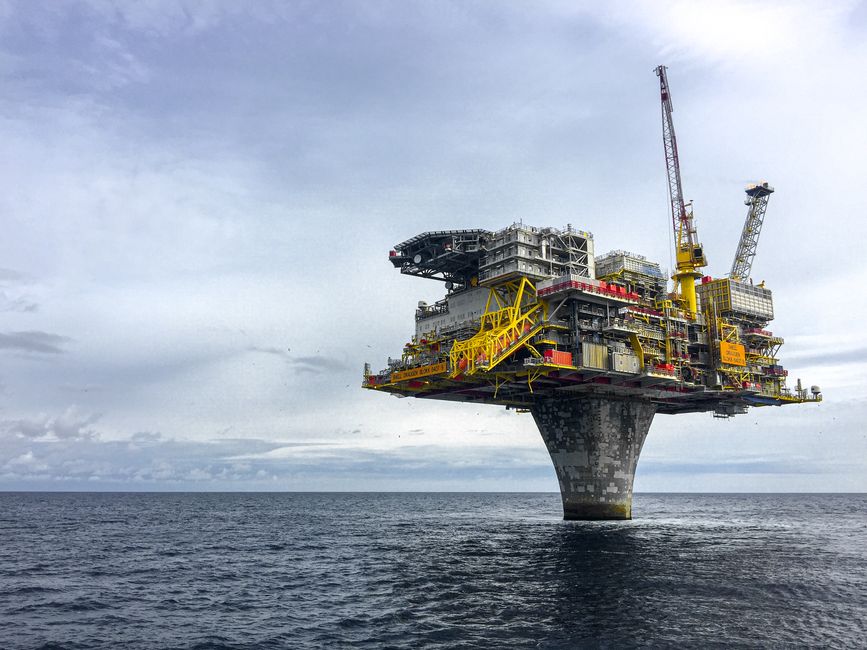
Photo: Jan-Rune Smenes Reite
Norway's oil workers are giving their employers until Thursday to agree to pay rises above inflation. If talks collapse, 617 offshore workers walk off their platforms on June 5, and the fields they would leave idle produced a combined 266,400 barrels of oil equivalent per day last year.
That is not yet a catastrophic number on its own. Norway pumps more than 4 million barrels of oil equivalent daily. But the unions representing workers at Styrke, Lederne and Safe have made clear this is an opening move, not a final one. The strike can escalate in waves, drawing in more of their 8,100 combined members over time. In 2022, a similar dispute grew fast enough that the government stepped in to force an end to it after energy companies warned it threatened to cut more than half of Norway's daily gas exports and more than 17% of its oil output.
The government has not yet signaled it will intervene. Norway's State Secretary Line Eldring said Monday that authorities are "monitoring all ongoing labour disputes" but that it is up to employers and workers to reach agreement. Under Norwegian law, the labour ministry can force a halt if it judges that vital national interests are at stake. That threshold has been crossed before, but it takes visible damage to trigger it.
Why this matters beyond Norway
Norway is Europe's largest supplier of natural gas, providing roughly one-third of the continent's annual consumption, and about 15 percent of its oil. European buyers have spent three years since Russia's 2022 invasion of Ukraine building supply chains that run through Oslo and Bergen rather than through Moscow. Norwegian gas is not a backup option for Europe anymore. It is the primary option.
Any disruption lands at a moment when energy markets are already stretched. Global oil and gas prices have risen sharply this year following the U.S.-Israeli war against Iran and Iran's subsequent blockade of the Strait of Hormuz, a key export route for Middle Eastern oil and liquefied natural gas. Removing Norwegian barrels from an already tight market would push prices higher, and European households and businesses would feel that in heating bills, electricity costs and fuel prices before summer is out.
The specific platforms named in the initial strike notice are Statfjord A, Ula, Draugen, and Oseberg B, C and East. Companies facing potential walkouts include Equinor, Aker BP, Okea and drilling contractor Helmerich & Payne. These are not marginal installations. Statfjord and Oseberg are among the longer-running fields in the North Sea.
What the workers want
The unions are seeking pay rises above inflation, along with other contract changes they have not disclosed publicly. Norwegian offshore work pays well by most standards, but inflation has eroded real wages across the economy, and workers in energy extraction are making the same argument that workers in many industries are making right now: that productivity has held up, costs have risen, and the gain should be shared.
The talks are brokered by the state, which is standard practice in Norway's highly coordinated labour market. That process gives both sides a structured path to settlement and gives the government a formal role if things go wrong.
If Thursday arrives without a deal, the first 617 workers strike. If the strike holds and pressure builds, the unions can add members in subsequent waves. The government watches, calculates the damage, and decides whether to invoke its intervention powers. That sequence played out in 2022 and was resolved by compulsion rather than negotiation.
The deeper issue is structural. Norway sits at the intersection of two pressures that are not going away: a European energy market that cannot afford supply shocks, and a workforce that has learned, from 2022, exactly how much leverage that gives them.